


Gunung Mulu National Park, Borneo
Caves, bats and Pinnacles
If you read my last blog about our ascent of Mount Kinabalu you will know that some 20+ years ago we backpacked around Malaysia when Carmen was just a wee lassie, small enough to still get a lift in a pack on our back on long walks. My dreams then had been to return to Borneo one day. And so it was Carmen and I now found ourselves on the way to Sarawak to undertake another of the treks that had been too tricky when Carmen was small: The Mulu Pinnacles.
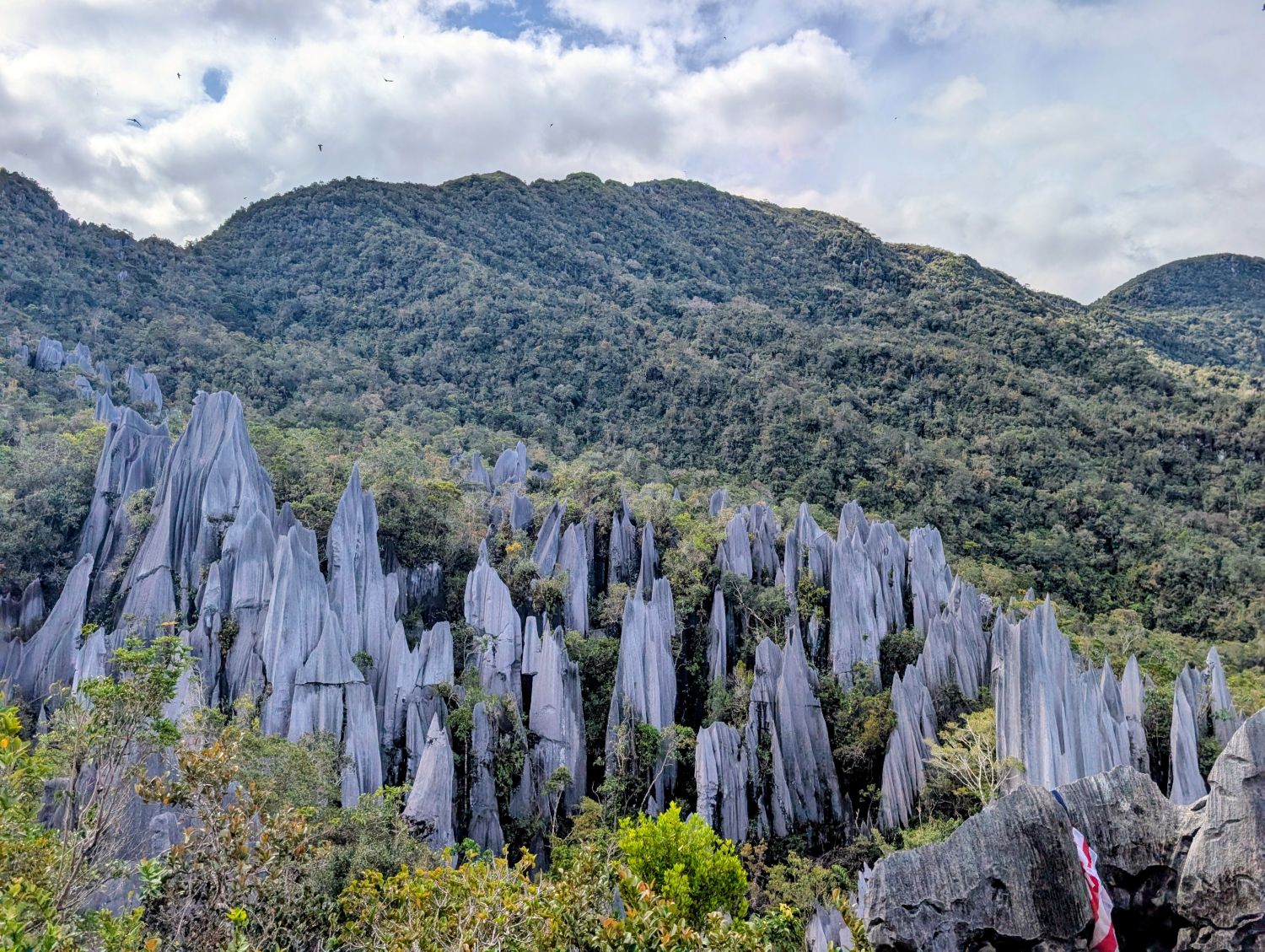
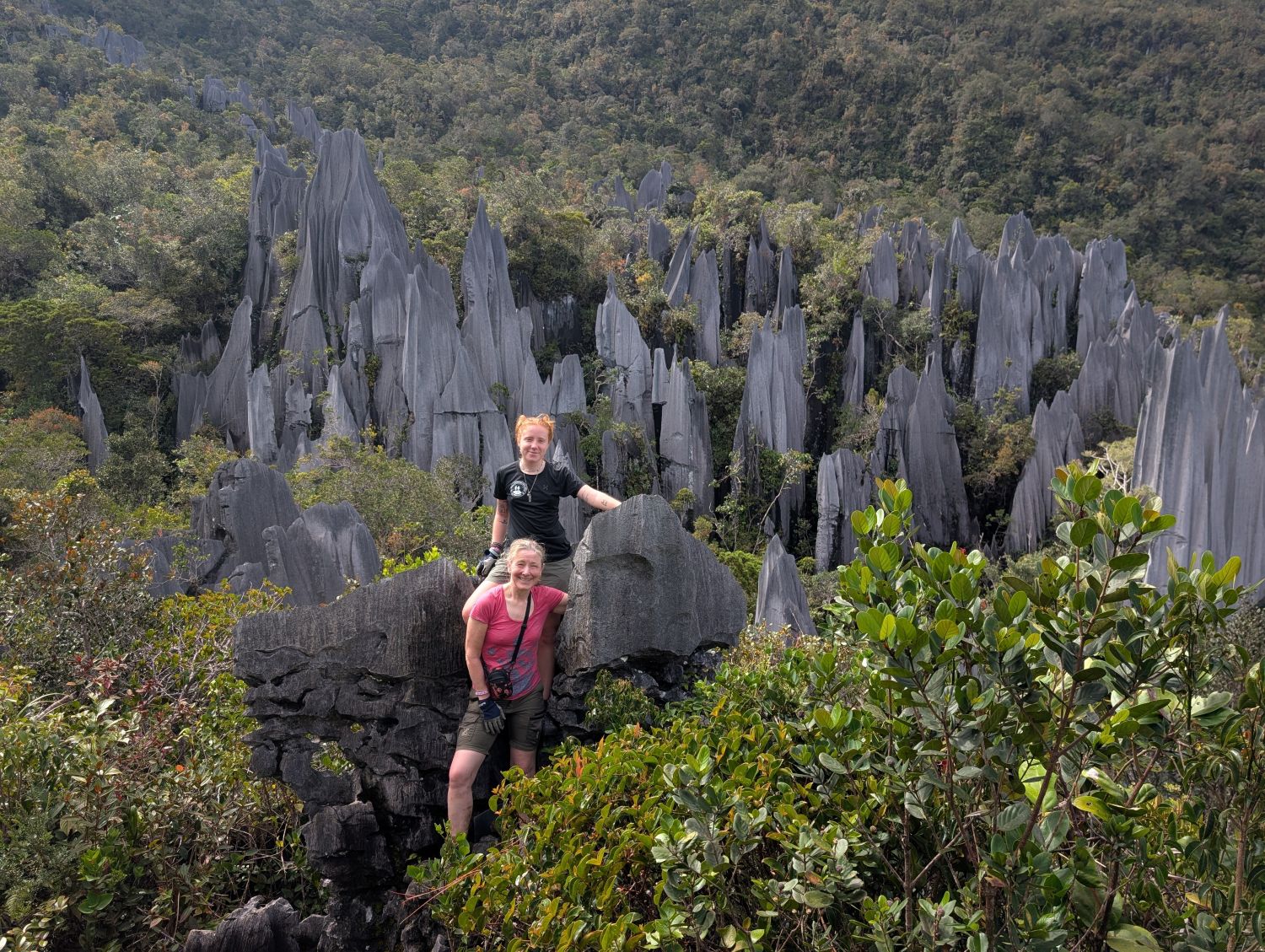
The Pinnacles are a wonder of nature. Razor sharp blades of limestone, some reaching 50m high, jut abruptly out of the Tropical Rainforest, part of a Karst Limestone Landscape formed through millennia of sedimentation and weathering. But unlike the flat limestone pavement of the Yorkshire Dales where we lived for 20 years, these knife-like structures are seemingly glued together by a rainforest, decaying leaves creating layers of humus over the centuries built up around them, pockmarked by black holes into nothingness.
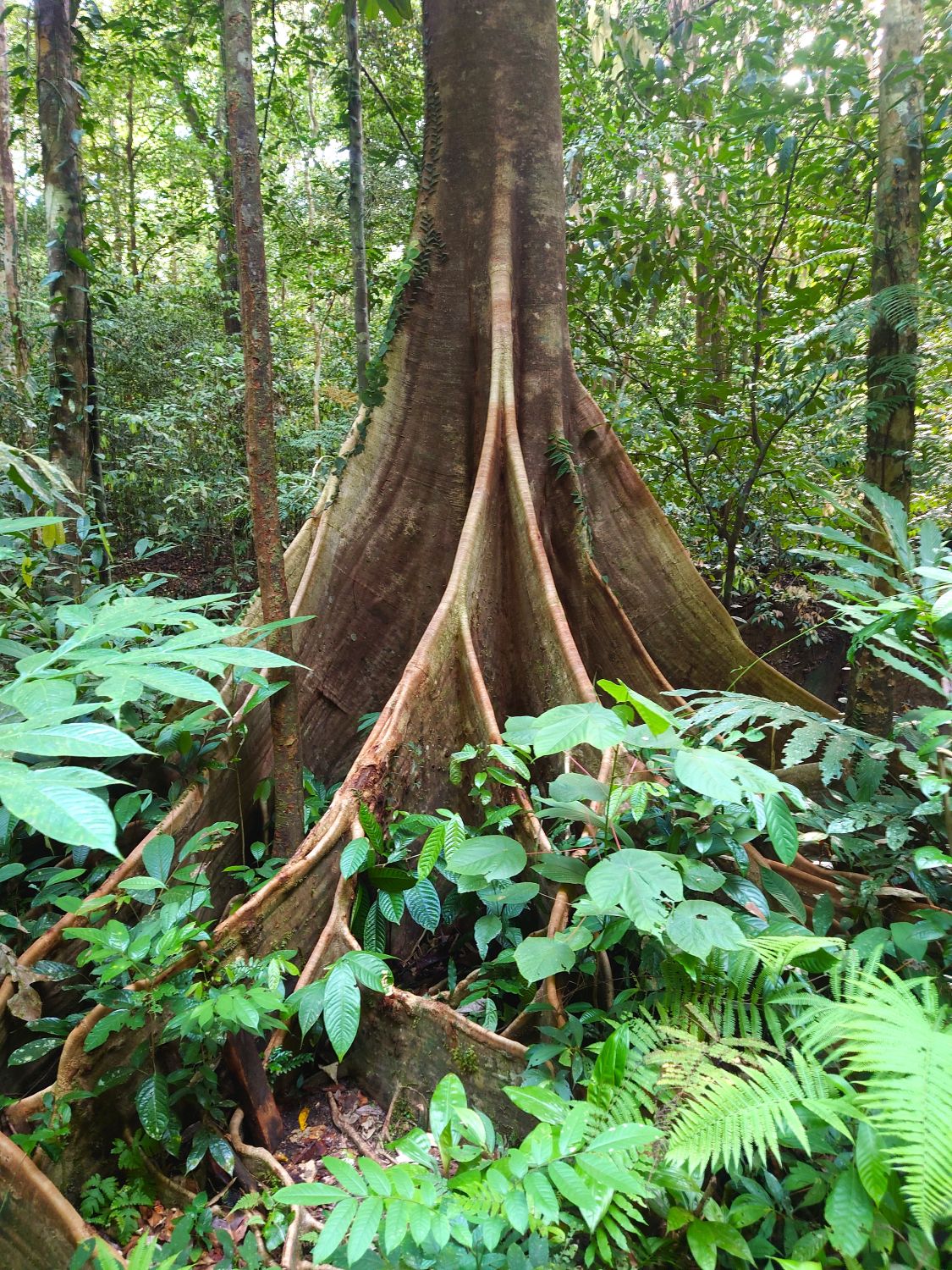
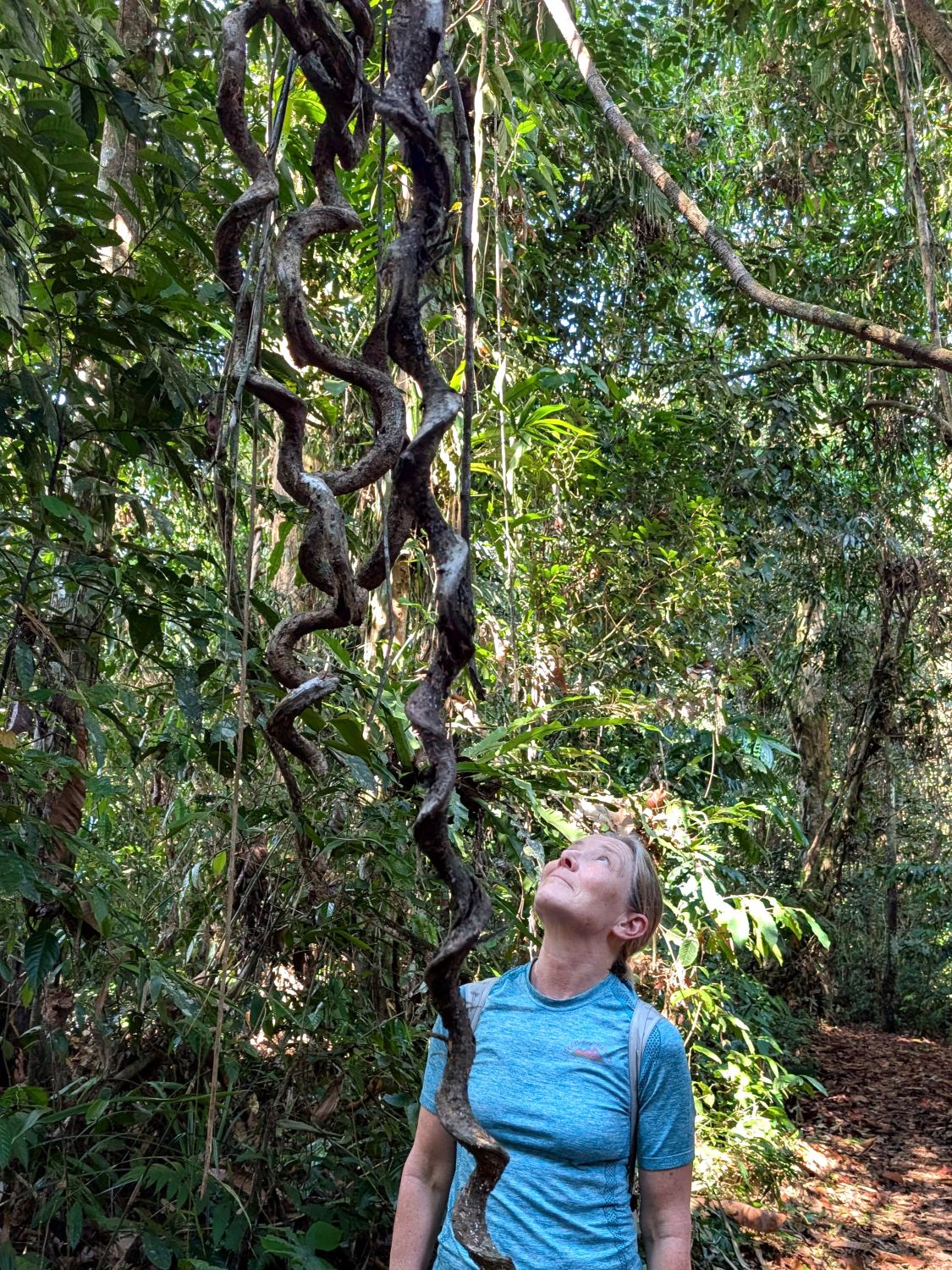
It is a treacherous and very beautiful landscape with numerous limestone peaks, sinkholes, cave systems, rivers; rich with forest, vegetation, wildlife and insects. Giant twisting vines hang from buttress trees, stick insects cleverly camouflage themselves against twiggy backdrops, shy snakes slither off into the rocks, butterflies as large as birds flutter colourfully through the forest canopy, fish dart into the shadows of clear waters – and the sound of cicadas, birds and frogs at sundown is quite something, enough to make even your eardrums buzz. And if you are very lucky you may see some of the shyer mammals, perhaps a pygmy squirrel or even a Bornean Tarsier, and quite possibly you will hear monkeys. But one of the species you are almost guaranteed to see - other than the dreaded mosquito - is Wrinkle Lipped bats – but more of that later.
The Trek
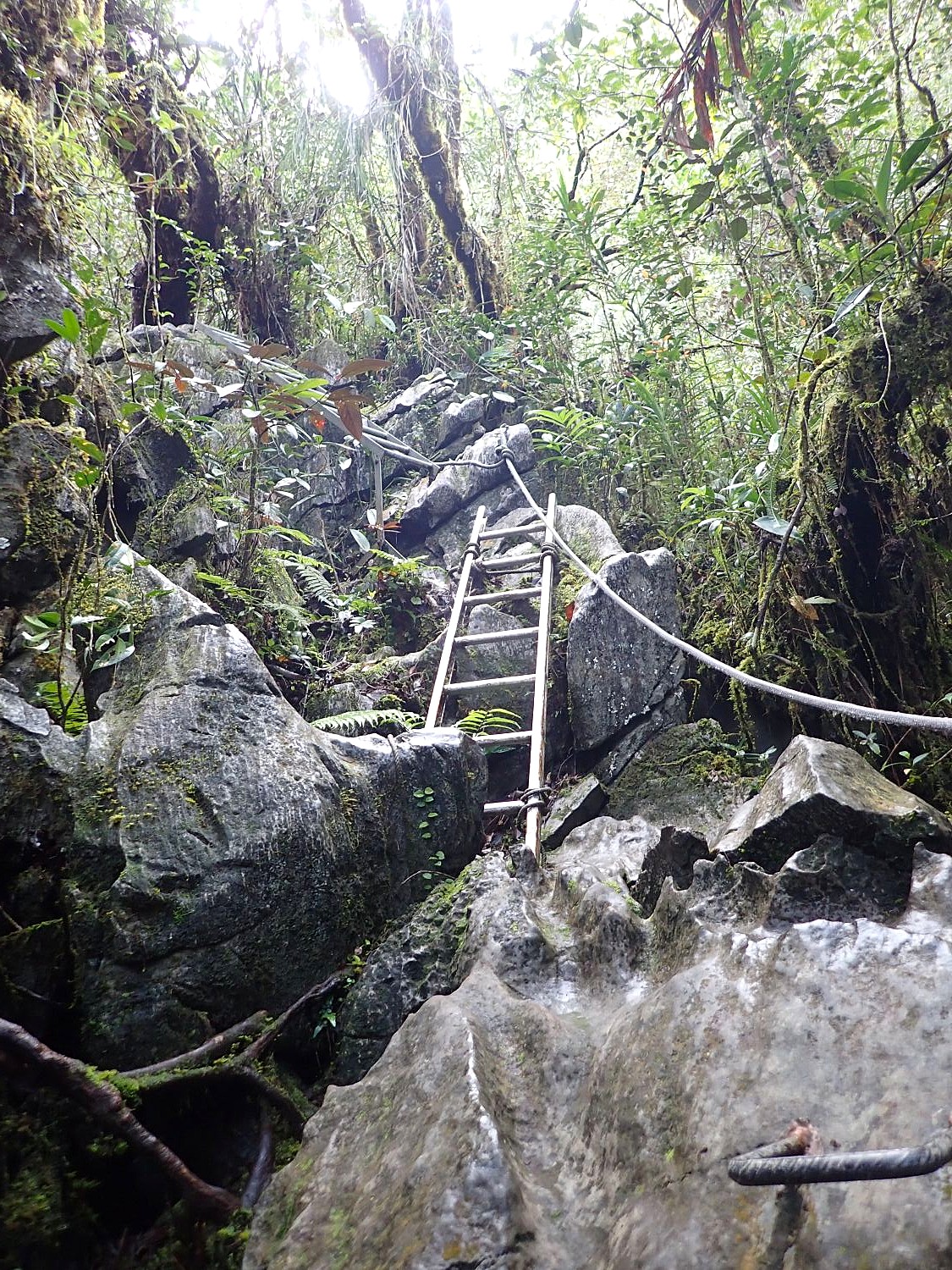
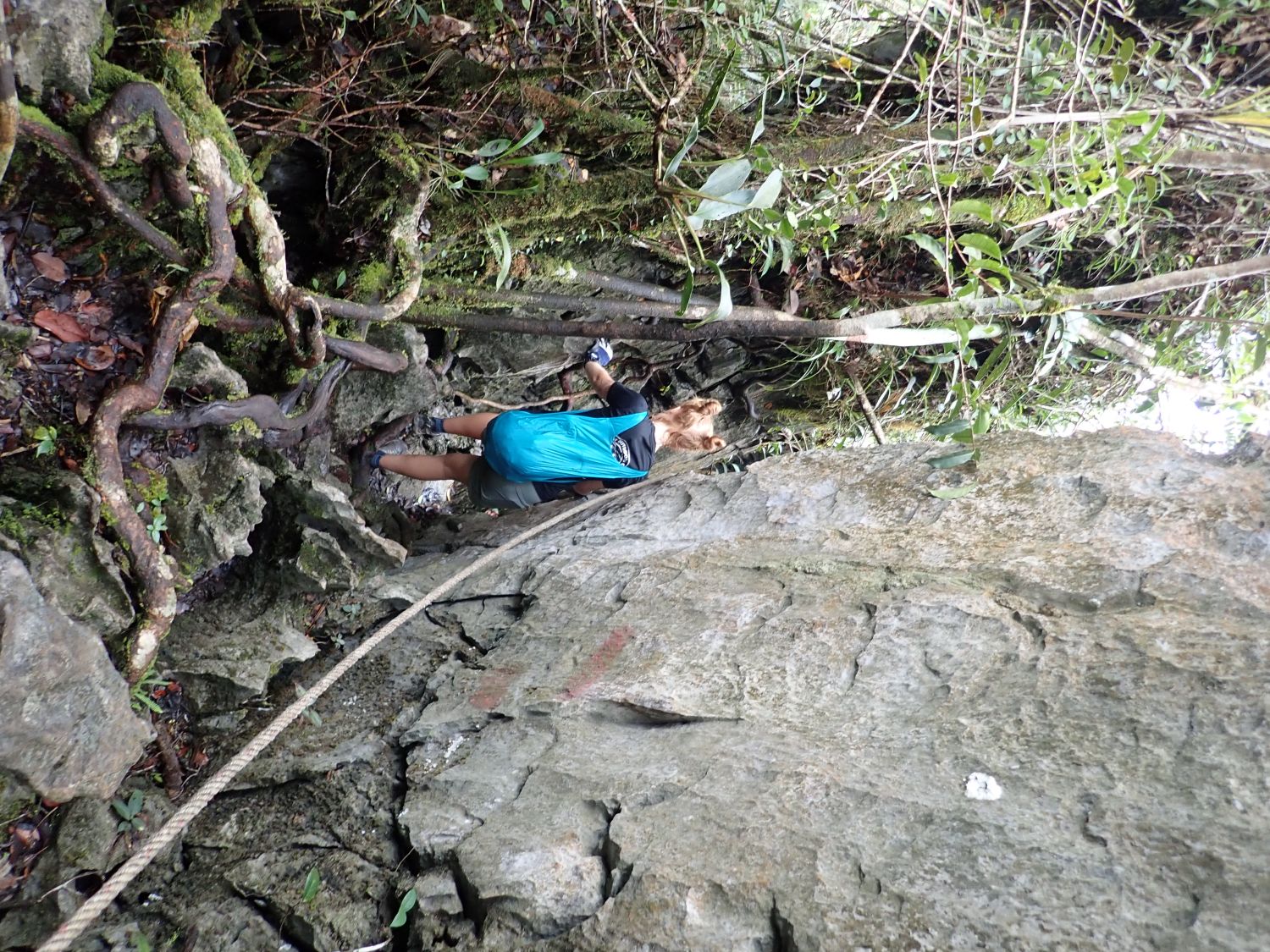
Although the distance to these jagged pinnacles - which seemingly erupt from the slopes of Gunung Api - and their ascent is relatively short, they are a notoriously tough ‘trek’. This is because they are accessed via the steep twisting, often very sharp, limestone rock faces and tortuous jungle roots. The route up is often near vertical, sections scattered with metal rungs, ropes slung between trees, and ladders. There is no Via Ferrata here, nothing to safely clip on to, so a head for heights and good footwork is essential – more so for coming down than going up.
The trek – as we did it booked via the National Park – is usually undertaken over three days.
Day 1
We met at park HQ with other like minded souls. The group was bigger than I had anticipated, some 21 of us. It was already getting hot. Glancing around I could see that I was most certainly the oldest other than a Russian chap. A group of young men from West Malaysia and most of the others, mainly couples, were in their 20’s or 30’s. Age does not matter but it did make me wonder how this would affect the general speed of the group – they were nearly all from Malaysia and used to the heat. I could only hope the trees would offer enough shade as I knew the heat would slow me down otherwise. I live in a house that is often around 14 degrees C!
Our journey started by navigating a short distance up the Melinau River by longboat. We shared a boat with the boatman, the bowman, a young Malay and the Russian. We did try to learn each other’s names, but I confess I struggled to hear what they said over the roar of the outboard. Our first stop was a visit to the Penan settlement and market at Batu Bungan but, being a Sunday, it was pretty quiet, not the usual buzzing market day. I was tempted to buy a rattan basket ‘backpack’, dyed with wild barks, but was not quite sure how I would get it home. It would have been a useful addition to my foraging courses.

The boat then took us to a little platform below the lovely Clearwater and Wind Caves. We had been to the caves on our last visit in 2005 but obviously Carmen could not remember them! The caves have a plethora of steps (initially there are around 200 up to Clearwater Cave), which are quite steep, but once at the entrance the meandering route through the various cave formations is very pleasant. Despite the general heat there was a welcome breeze in the Wind Cave, where the system’s eroded limestone tunnels allows the air to circulate through. Our guide stopped to tell us about some of the formations and sights, but we could tell that he didn’t want us to dawdle for long. Back down at the boat Carmen and I managed a quick paddle as there was not quite enough time for a swim; I remembered swimming here last time, the cool water a welcome respite from the sticky rainforest heat.

The journey up the river continued until we reached rapids that were now too shallow to navigate due to the lack of rain. Initially our boatman thought he and the bowman could get us upstream and he kept revving the outboard part way out of the water, creating a haze of smoke, whilst the bowman paddled furiously. But it was to no avail. We had offered to get out once already and this time he was happy for us to do so. Not only did it mean we could walk the boat upstream, we could also cool our feet again.
We did not see much wildlife, the odd bird or dragonfly; the heat was probably keeping the creatures to the cooler shadows. The sun beat down relentlessly and we were glad of the breeze as we sped up the river.
The boatman dropped us off at the little sandy bank at Kuala Litut. From there it is an easy flat 9km hike through rainforest to Camp 5. That said it can get very muddy/swamped after rain with small streams turning into uncrossable torrents (this may sound familiar to regular TGOers who cross Scotland); we were lucky as underfoot it was unseasonably dry.

The path meandered amongst buttress trees, tall drooping ferns, over suspension bridges with rivers gently trickling rather than thundering and along sections of boardwalk. It was all very civilised and easy – giving a false sense of security as to what was to come.
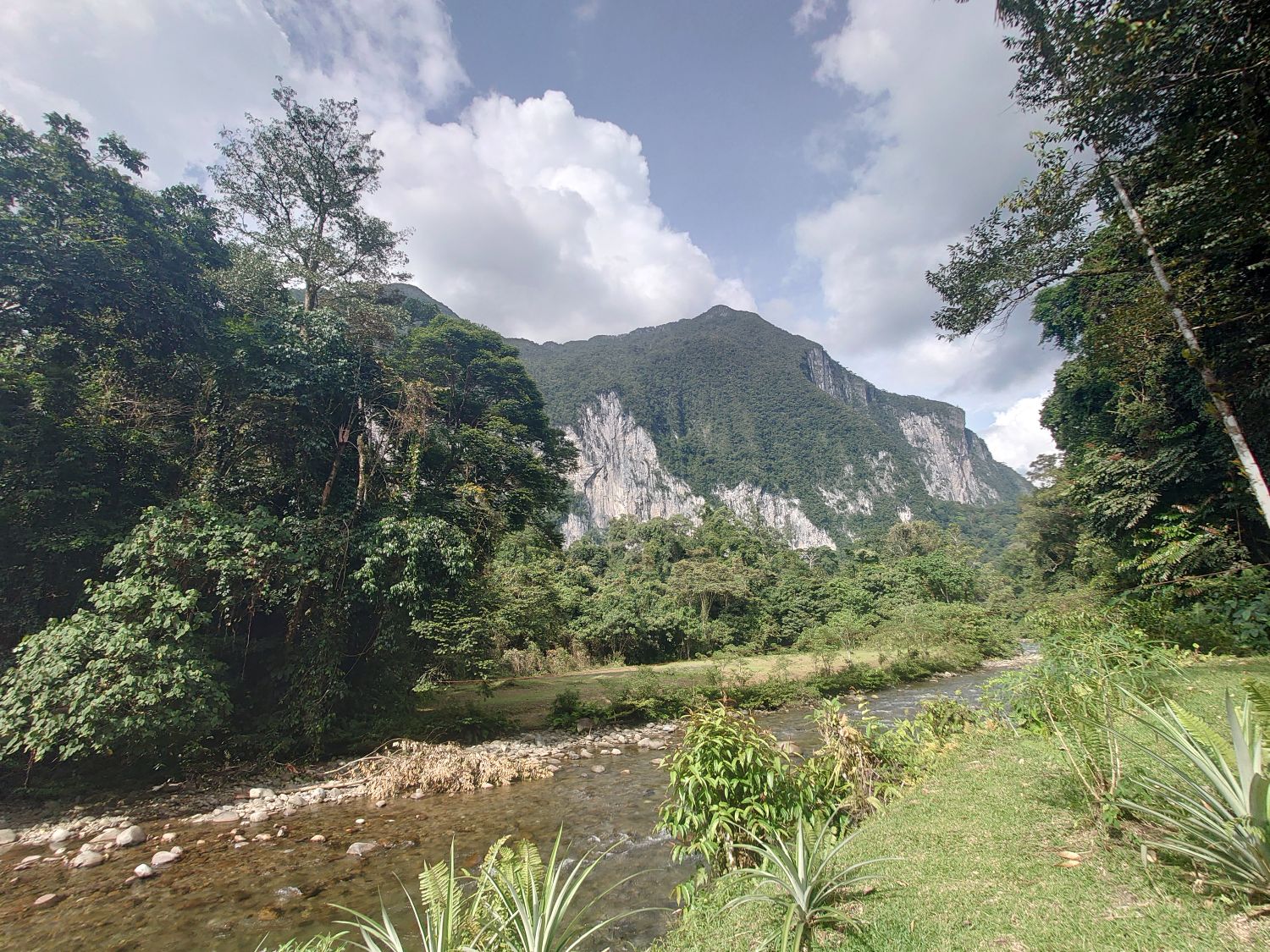
Camp 5 was in a lovely position next to the river by the Melinau Gorge. And of course, it was so hot and sticky that the first thing that came to mind was to dump our gear and swim. Everyone else thought the same so there was soon quite a party of people in the water, which was sparkling and clear, running down through the limestone of the surrounding hills.
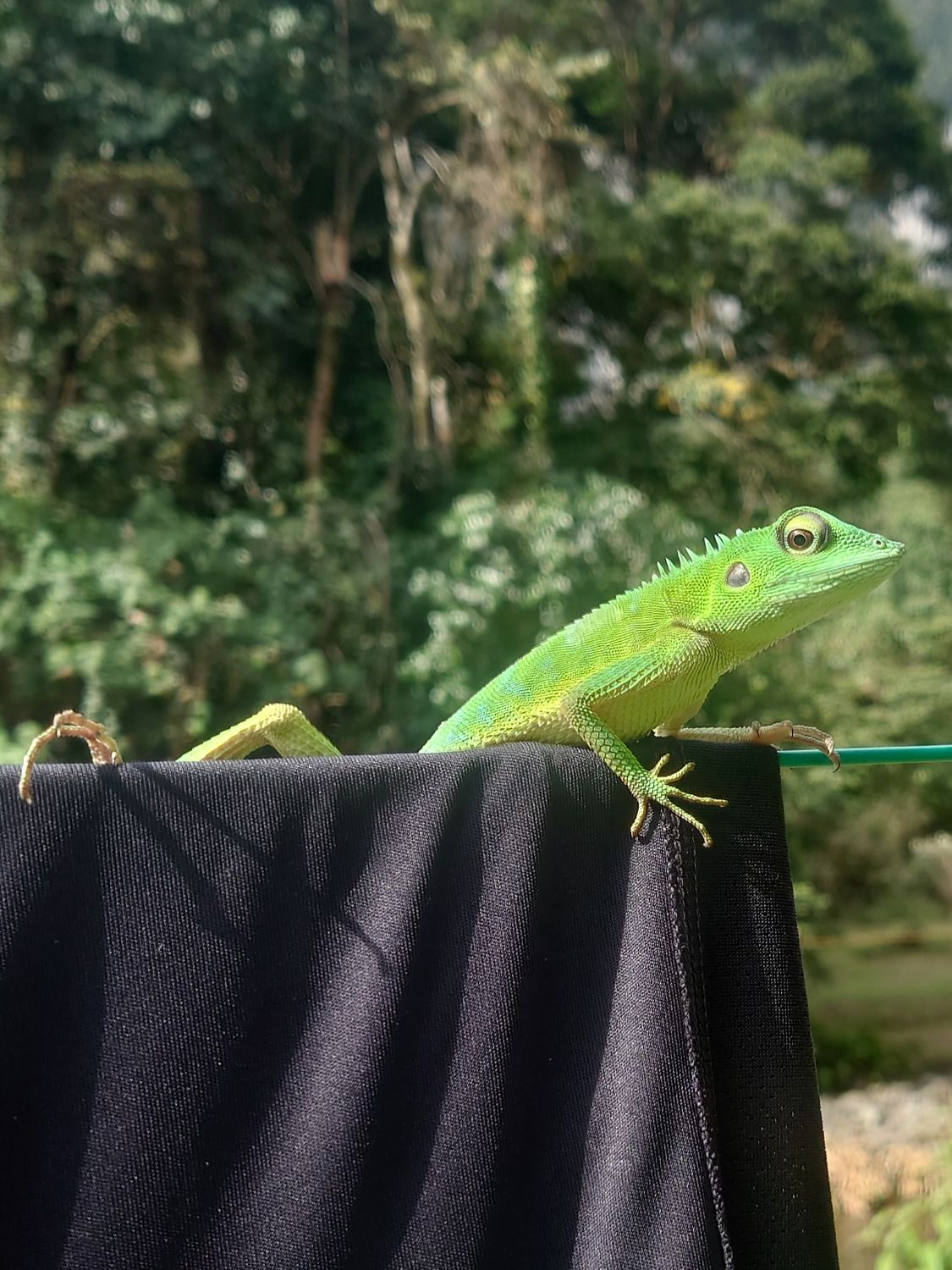
Cooled down we changed and dried our swimming gear out in the sunshine. And then came the Green Crested Lizard. Initially it came hopping through the grass towards Carmen so she thought she would take its photo. It posed appropriately and she ducked down to ground level to get a better shot.The lizard then ran, a gangly swagger at incredible speed, before leaping - right onto Carmen’s head. And then it got stuck in her hair. They both panicked and it somehow leapt onto the washing line where it stayed. I was so busy laughing I did nothing to help. It then appeared to pose and let us take more photos. It briefly came onto my arm before retreating again; it seemed surprisingly used to people. These lizards are not renowned for being tame, so we were privileged to get so close.
Our dinner consisted of a dehydrated meal I had brought from the UK. I knew we would have to carry all our food in and had not been sure what we would find that was light to carry other than instant noodles with little nutritional value. Indeed, we noted that was what quite a few others ate. We had brought Expedition Foods and Radix Nutrition meals from Ultralight Outdoor Gear, all of which were pretty good.
After dinner our guide - who called himself 'Ronaldo', came to brief us about next morning’s plans and we were soon opting to get to bed.
The open sided dorms consist of long wooden platforms under a roof with thin mattresses over which you hang your mosquito net. You could sleep around six to a platform. We had our own sleeping bag liners and nets, but you could hire the latter from the Park too. Because of the open sides you are mosquito bait, so nets are essential. Even so, we still got a few bites; luckily Mulu is not a high-risk area for Malaria, mainly as such vast numbers of mosquitoes get eaten by the very large population of bats.There is also no privacy, and you share dorms with whoever is there, so changing was definitely easier in the loos, which were kept immaculate.
That night as we turned in, we had a thunderstorm. The lightning and thunder were terrific. But more worryingly, so was the rain; it hammered it down.
Day 2
So this was the day we had come here for - the tough ascent to the Pinnacles. We knew that to get to the point where you can view them involves a near vertical ascent/descent. It is only 2.4km each way but involves a total height gain of approx. 1.2km. Think climbing a Munro via jungle roots, slippery limestone and ladders.
We also knew that to do this you have to have a guide – there is no choice in this, it is a safety rule set by the National Park. The terrain is the main reason and the cut-off times as you ascend are very strict – so if you don’t make a cut-off time you are not allowed to continue. I soon came to see why they wouldn’t want anyone dawdling down at dusk; it is very tricky and slippery underfoot and a rescue in such remote terrain would be a nightmare.
When you book there are a lot of warnings about the dangers and cut-off times; they clearly state that you need to be ‘ABOVE AVERAGE FITNESS & EXCELLENT HEALTH’ and that ‘THE PINNACLES IS A HIGH RISK ACTIVITY!’. And if it’s chucking it down you are not allowed up. Basically, you go in knowing that it's going to be tough.
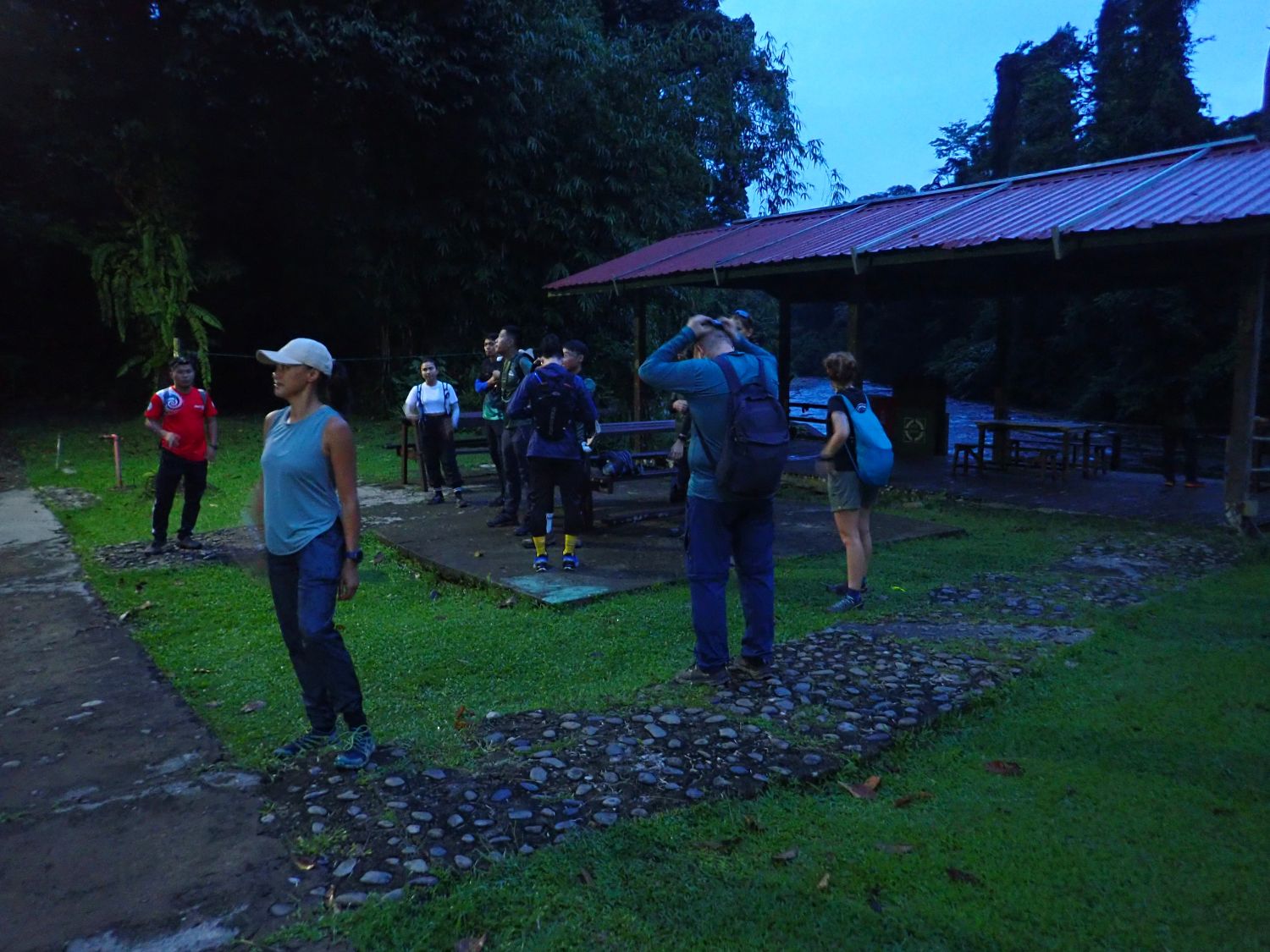
That morning we were all worried about the previous night’s heavy rainfall. Would the guide cancel? But it was fine – he said as it wasn’t raining at that point in time, we were good to go, but that it would be very slippery. Having lived in limestone country I knew exactly what that could mean.
It turned out there would be three guides interspersed, front, middle and back. 19 of us set off, sadly leaving one lad behind who had turned his ankle en route to Camp 5 and another who had an older injury which was playing up. Even with the knowledge of the terrain, which I had mentally prepared for, you can’t avoid the fact it’s very hot work – it gets to 30+C during the day and is incredibly humid. I found the heat harder than anything!
After a brief easy meander, you are straight in there – up a steeply rooted path (if you can call it a path) where you are just looking up above your head for the next foot or hand hold most of the time. Some of the group and the Russian sped off with the guide at the front, disappearing into the vegetation - I suspect Carmen could have easily kept up with them. The cut-off times put you under pressure to keep moving; you felt the need to keep going which also made it hard to cool down. We made the first cut-off and relaxed slightly. Here you drop off some of your weight – water for on the way down. I thought back to the Challenge walks I lead in the UK, where its more about distance and stamina than fast, short nearly vertical ascents. I have always been a long-distance person rather than a sprinter!
Refreshed from our break it wasn’t long before we were off again, scrambling up steep and slippery rocks as we went. En route Carmen nearly put her hand on a snake, luckily it was more scared of us than vice versa and it quickly slithered away; I was glad she was wearing gloves. We are still not sure which species it was but it did look like a small viper.
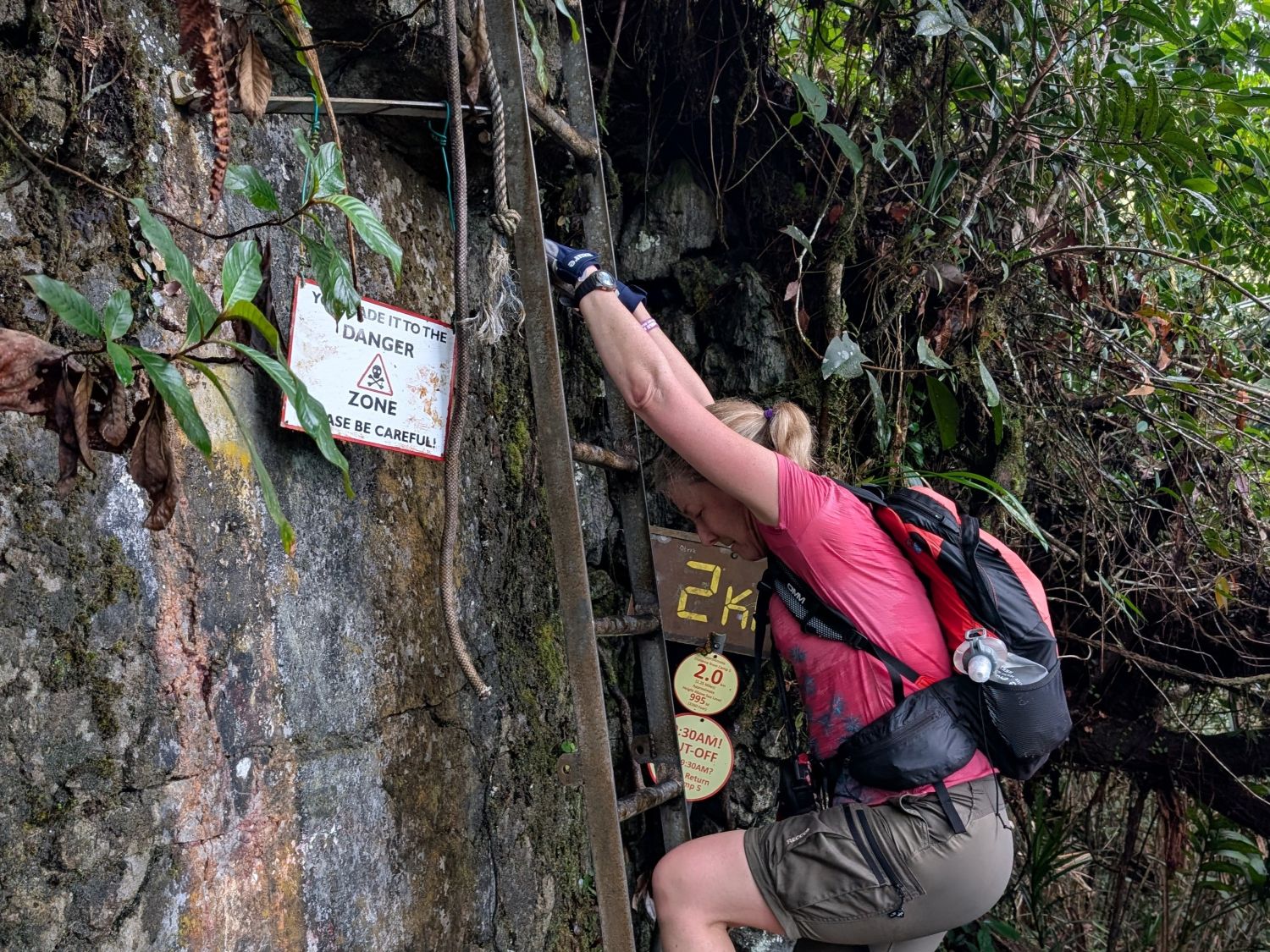
Our next goal was to reach the bottom of the ladders before the next cut-off time. As it turned out we had over an hour to spare but not everyone assigned to our group made it - as said, the cut-off times were very strict!
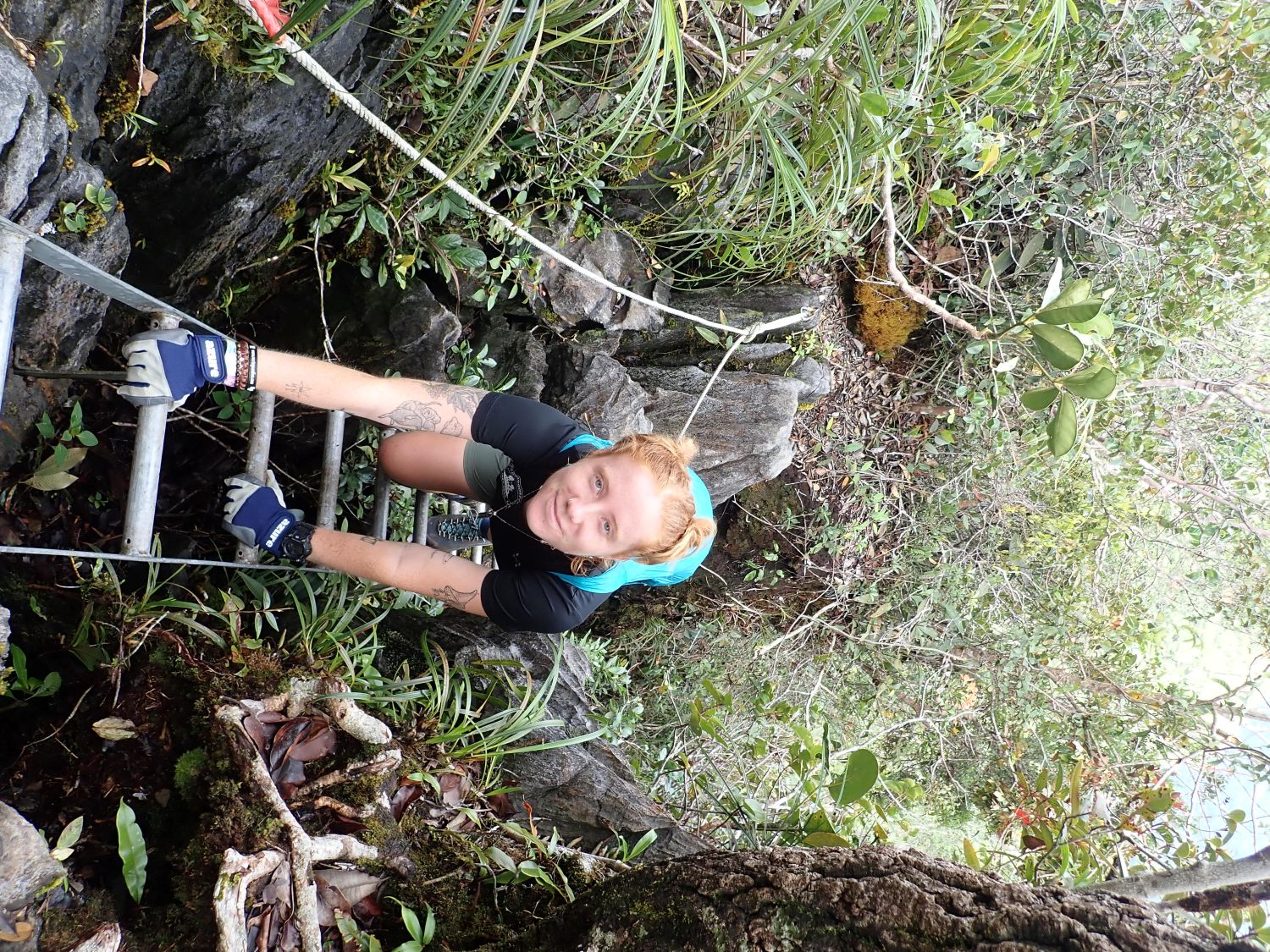
The ladders, metal bars and rungs interspersed between the steep sections of limestone and sinkholes and gaping crevasses certainly made for an entertaining ascent. We really enjoyed it but you certainly wouldn’t want to slip, some of the crevasses looked bottomless. Concentrating on where to put your hands and feet kept your mind off the actual physical heat of the ascent, and the air did start to cool slightly which was welcome.

The sight of the actual Pinnacles is really quite something. One minute you are in thick rainforest, the next you pop out on to a ridge and there they are. We spent quite a long time just gazing out at them before getting the obligatory photographs. It was certainly worth the effort.
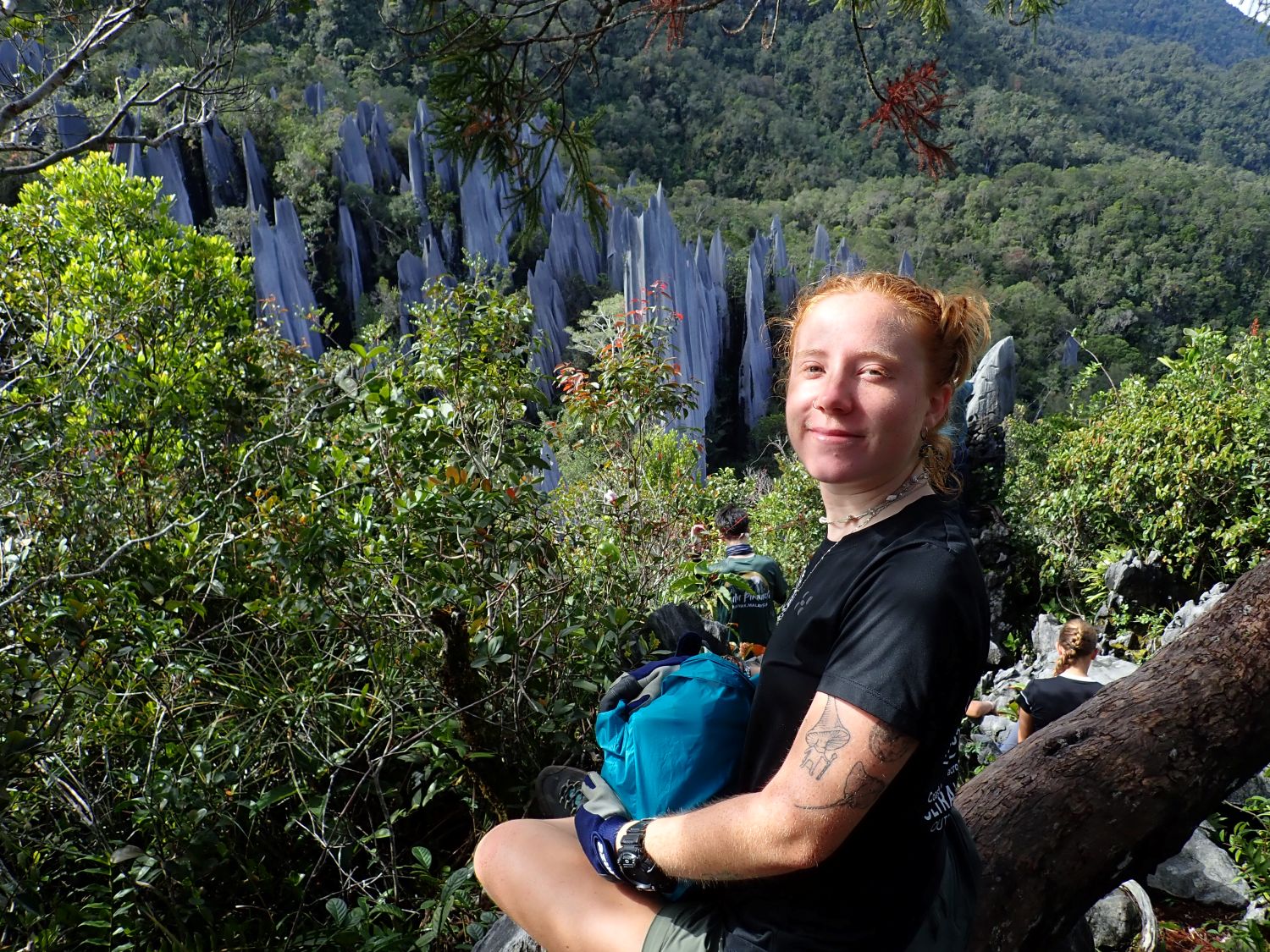
Going back down took us pretty much the same time as going up. You really did need to take care as a fall onto the sharp section of limestone or tumbling down the steep roots would not have been a good way to end the day. One of the others did gash their leg slightly but luckily not too seriously. We were so busy concentrating on the roots as we went down we didn't capture how steep they were!
It took us 61/2 hours from Camp 5 and back, with plenty of time to view the Pinnacles. A couple of super fit (or much taller!) folk were quicker, but most took longer due to the tricky descent. Scrabbling up and down Scottish hills, bog and heathery slopes with a full pack over the years definitely helped prepare us for coming down!

We spotted some interesting bugs, beetles, a snail with a weird parasite and heard monkeys as we descended. We carefully bypassed Giant Forest Ants, spiders and then had the wonderful sight of butterflies ‘puddling’, to collect minerals, on a section of path that had had a good soaking with the previous night’s rain.
Of course, it was the obligatory swim that came first on return to Camp 5, before a relaxed (dehydrated) dinner and an evening of card games, including an Asian style poker game (Dai DI?) with the young Malay lads.
Day 3
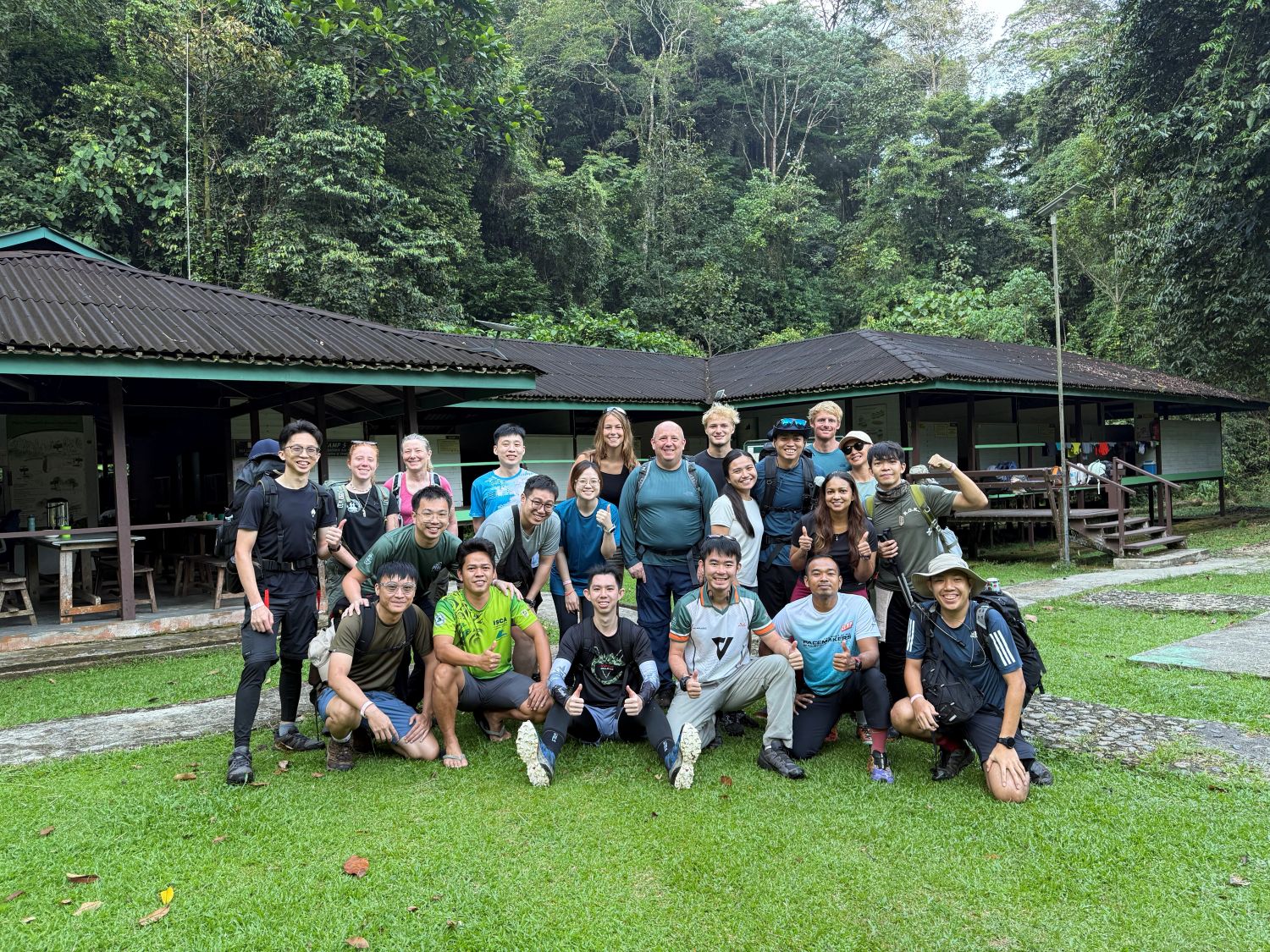
After a final photo of us all as a group we started at an easy daunder back down to the boat looking at the various trees, plants and chatting to Michael, one of the Malay lads. We then realised, as one of the young couples - who had also set off late -overtook us, that we needed to quick march; we sped up dramatically to get down to the boat that would take us back to Mulu.
%20for%20lunch%20Heathery%20Heights.JPG)
For ease we had lunch at the Park run restaurant. It had a reasonable vegetarian offering and local coffee although everything tended to be a bit oily. Replete we returned to Mulu Tribal Homestay where we had left our main luggage. The couple running the homestay (Denny and Salina) are lovely and we had a nice time there. They were good company and we had a few chats post dinner. Denny had helped clear the route to the Pinnacles back in the 1970’s and had worked in the Park for many years. Although he and Salina had been born to different tribes, this did not seem to have mattered in a more modern Sarawak that had been brought into a degree of harmony by the Brooke family.
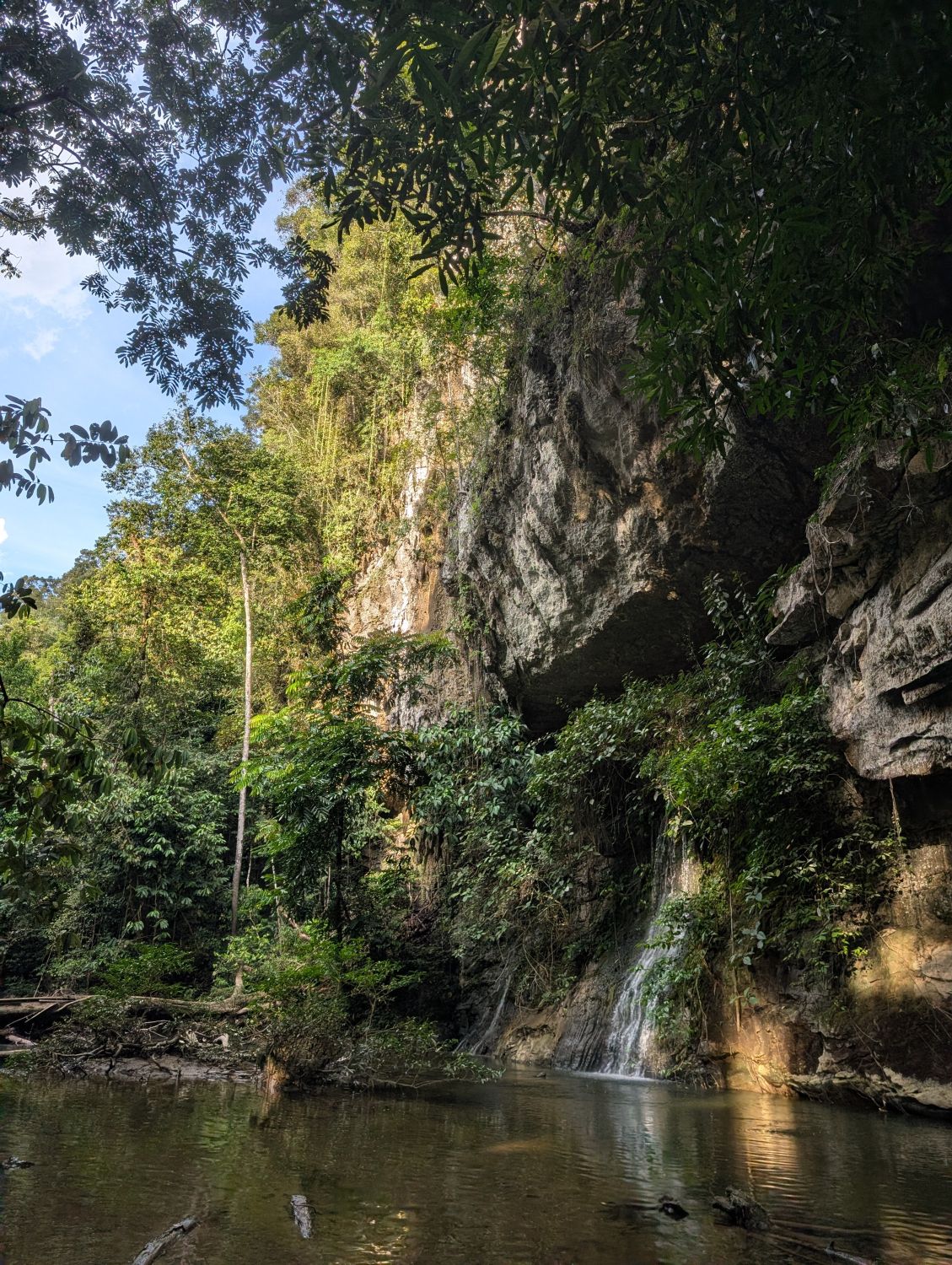
That afternoon we decided to go on another hike, a pleasant 8km circuit through the rainforest from the Park HQ, to swim at Paku Falls. It was quite hot again so we were glad of the shade from the thick canopy. On reaching the falls we had to find an easy access point and avoided a log that looked as though you were more likely to drop off it. It was whilst swimming that we met the Russian again. He came down to chat and leant against the aforementioned log. Then, to our and his horror, found himself absolutely covered in a mass of red ants. Luckily, he managed to brush or shake most of them off so he only got a couple of bites. He must have disturbed a nest; we were glad we had not chosen that particular log to leave our clothes and towels on! The other surprise was the small current of the river below the falls. It was much stronger than it looked despite the falls being very low – we both had to swim much harder than I thought we would to get back out again - there was obviously a deep flow coming in from elsewhere. It was quite comical but not dangerous (although it would be with sufficient rain). And cue for that evening, the rains came down hard and Carmen got drenched on our way back, having decided my brolly was just not big enough for two!
Mulu Trails and Bats
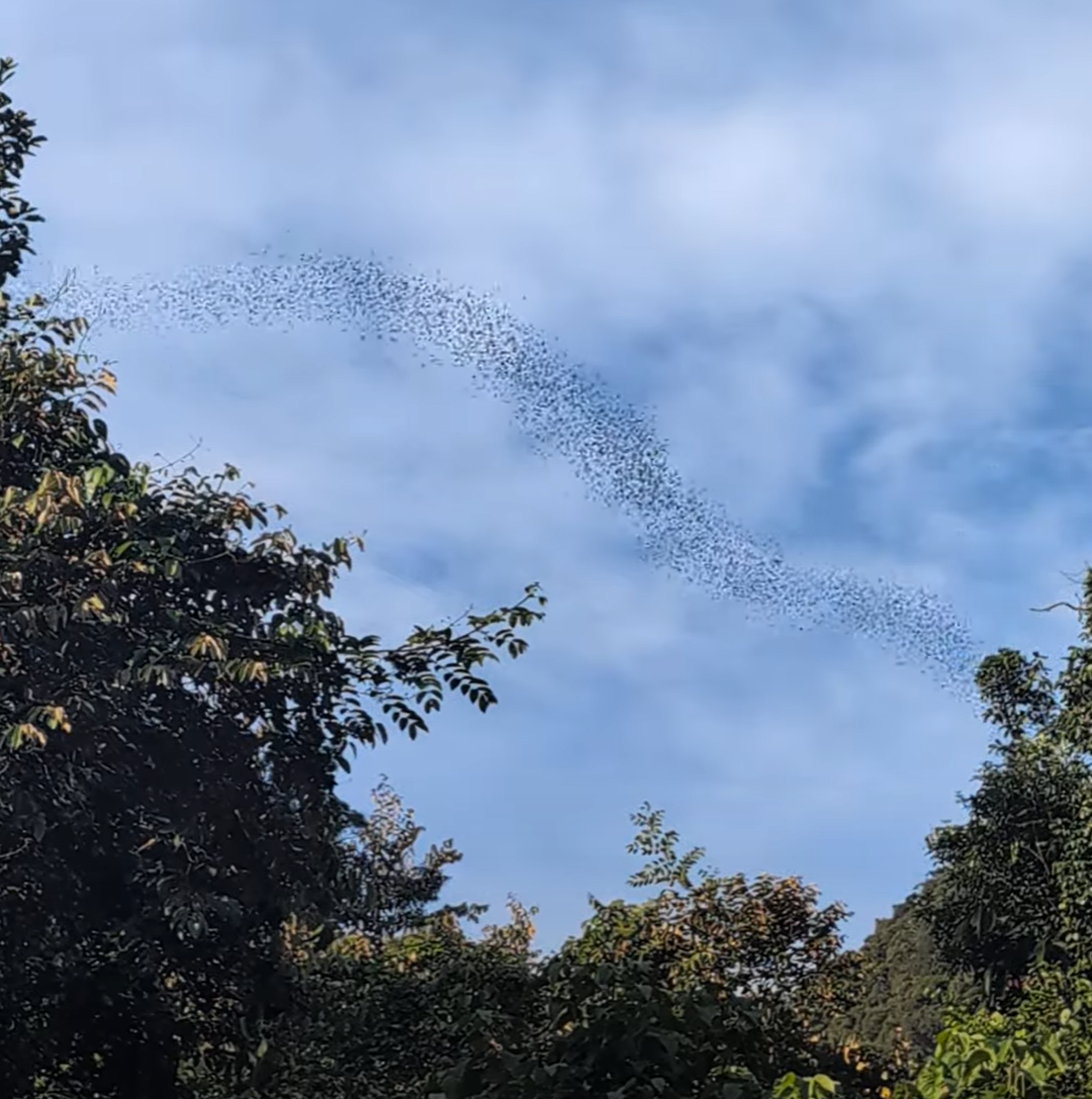
We spent a couple of days in Mulu to enjoy the rainforest trails and, of course, to visit the world-renowned Deer and Lang Caves. The former, a huge cavern, over 300’ high in places, is famous for its home to some 3 million Wrinkle Lipped bats – as well as large numbers of Swifts - which usually come out in a mass exodus to feed at dusk. It is no wonder the insect population in this area is kept at bay.

We had seen the bats exit the cave on our first day in Mulu at quite close quarters as they had flown low past us when on one of the trails. Ironically the day we visited Deer Cave the bats exited and flew out at a much higher level so, although in impressive murmurations, our view of them from the ‘Bat Observatory’ was more distant. But it was super to see them – it had rained hard on two of the days we were in Mulu and the bats had not come out during daylight at all.
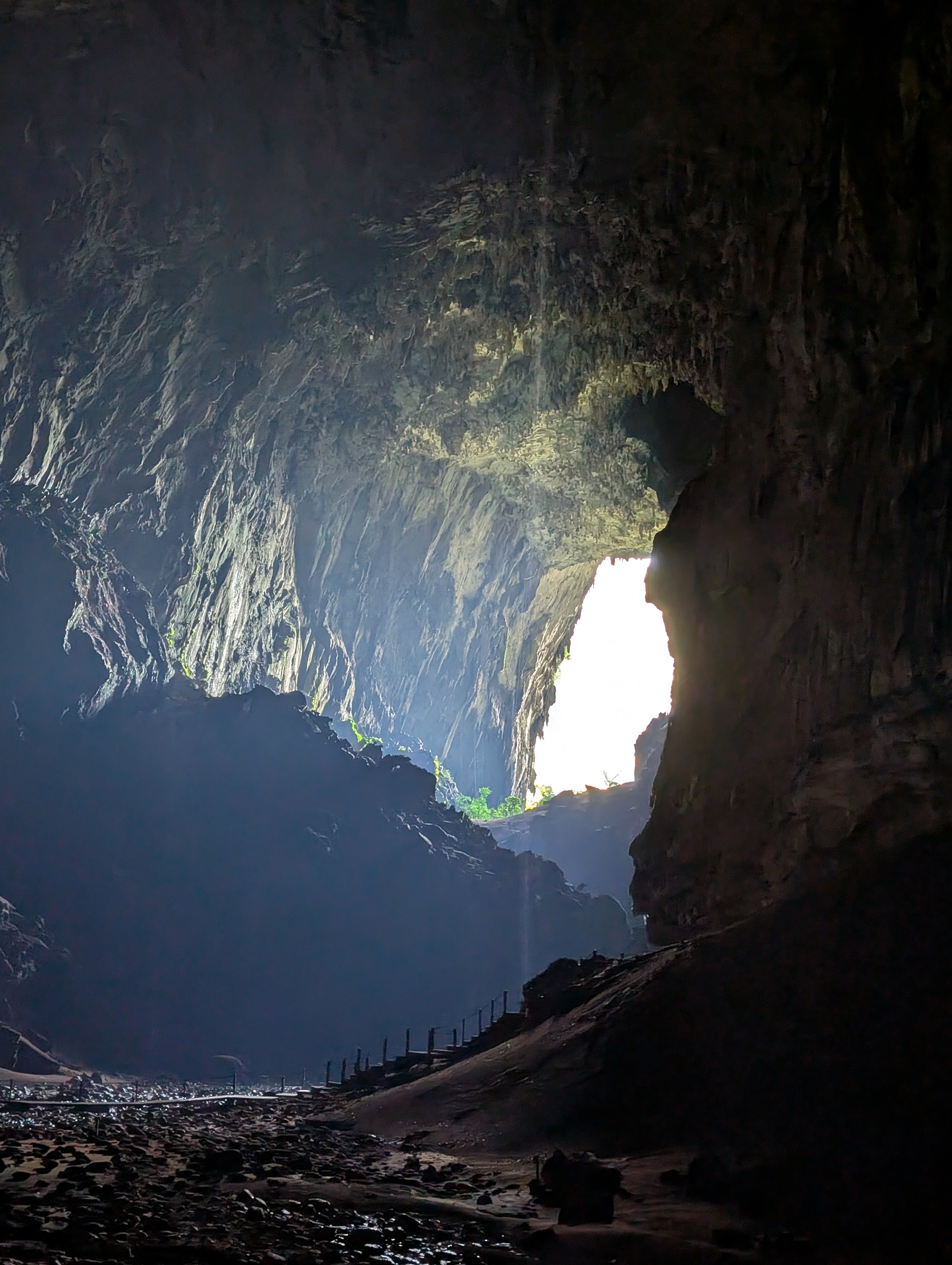
Lang Cave was also well worth a visit. Whereas Deer Cave is a vast cavern – one of the largest in the World - Lang has a more intricate set of tunnels with some wonderful formations, which are very easy to view. As soon as we started walking through them, I remembered the sheer size and some of the formations, which we last saw 20 years ago when Carmen was little more than a toddler. Time shrinks in such moments.
If we had had the time, we would like to have hiked to the summit of Gunung Mulu and spent time underground Adventure Caving. The Clearwater Connection looks fun, but you do need evidence of your caving experience or club (or you can undertake sessions there to ensure their guides are happy you will manage!). As always, the world has much to see……
Travel Tips
You have to have a Park Permit, book a Guide and your accommodation at Camp 5 to undertake the Mulu Pinnacles. The easiest (and cheapest) way is to book through Mulu Park who also have pretty much all the information you need regarding essential kit, food, etc. We brought some dehydrated meals with us from the UK as they are harder to get hold of in Malaysia but you can buy noodles etc easily enough before you come to Mulu. Although the park and a couple of local stores have some basic provisions I wouldn't rely on them. You just need to remember that you will need to carry your own food and bedding, etc if you book through the park, so keep it light! Although there is potable water at Camp 5 it is best to bring your own so you don't diminish all the supplies; there is nowhere to collect water on the actual trek up to the Pinnacles so a filter won't help on the climb. You need 3 litres per person for the Pinnacle Day - this is a strict rule - so that's 3kg added to your pack straight away!
Of course, if you want someone else to worry about cooking and the food, etc then you can book through a tour company, but the cost will be much higher and the guides must be registered with the park. It won't really make any difference to your accommodation - you will still be sleeping on a platform with everyone else and sharing the same facilities. That said if you have your own private guide they will be able to point out species etc to you on the walk in (and maybe things you would not otherwise spot) - we walked the route to Camp 5 alone so did not have that privilege, but we did some other walks in the park and found the park guides and information boards to be excellent.
We brought our own mosquito nets but these can be hired from Park HQ. Swimwear and a towel are a welcome addition as the river is good for a dip and cool down.
Flights into Mulu are now with Air Borneo, who recently took over from MA Swings. You can get direct flights from Miri, Kuching and Kota Kinabalu.
There are a number of good homestays at Mulu (I can happily recommend Mulu Tribal Homestay; simple, clean and friendly within a two minute walk of the airport and ten minute walk to the park entrance), lodge accommodation at the park, a number of eateries and, if you want a hotel, there is a Marriott Resort and Spa.
Just be aware that even a short walk is hot and it can be torrential. A brolly/poncho, sunscreen and insect repellent are all necessities as well as plenty of water. Walking poles might be useful on the flatter trails but are useless going up the Pinnacle Trail and you are likely to get them caught in roots coming down.
And be careful what you touch - there are some very beautiful but venomous caterpillars and snakes around, although the latter are usually pretty shy. And there are some very prickly - and sometimes poisonous - plants too, including Rattan. Some plants are home to ants which will protect them, so you don't want to upset the ants either! We chose to use our Via Ferrata Gloves on the steeper sections up to the Pinnacles as you are grabbing quite a few rocks, etc and Carmen nearly did grab a snake!
The best time to visit is between March and October with the summer months being the driest. That said, we were there in April and it was unseasonably dry although there were a couple of early evening downpours.
The wet Monsoon season runs from November to February and makes treks, climbs and caving much more hazardous so these may not be possible.


